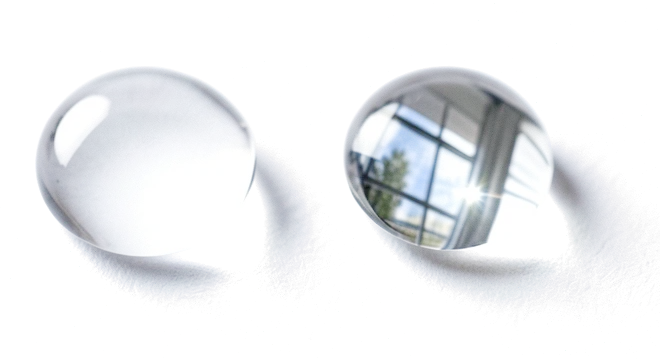
The thought arrives before I do
Try not thinking about anything for ten seconds, right now. Most likely, by the third or fourth second a thought will show up: "am I doing this right," "what comes next in this text," "I need to answer that email." You didn't call it. It came on its own, like a notification on a screen.
When I first really noticed this, not as an idea from a book, what surprised me wasn't that thoughts appear unasked. Something else did: someone noticed. If the thought is me, then who is watching it from the side?
You can approach this question through philosophy, through neuroscience, or through meditation. The engineering view is closest to me. I'm a systems engineer by training, and I'm used to asking the same thing about any system: where is the data, where is the processing, and where is the interface through which the user interacts with all of it.
An interface between me and the world
An interface is the layer through which you see a system and control it. A good interface is invisible: you tap an icon and forget there are millions of lines of code underneath. That's exactly why it's so easy to mistake it for the system itself.
The same happens with the mind. It shows me the world already processed: this person is dangerous, this task is boring, I won't manage. The picture arrives so fast and looks so convincing that I take it for reality. Alfred Korzybski put it this way almost a hundred years ago: the map is not the territory.Source 2 I'd add: and the interface is not the user.
When I say "the mind as an interface," I'm not belittling the mind. It's a brilliant system: it saves attention, predicts, fills in the gaps, protects. But an interface has one property that changes everything: it can be redesigned. Not all at once and not completely, but it can.
A thought is an event, not me.
A brain you can rewrite
Not long ago it was believed that the adult brain barely changes: whatever has formed by twenty-five is what you live with. Today that view looks outdated. The nervous system rewires itself under the influence of experience throughout life, and this is called neuroplasticity.
My favorite example is London taxi drivers. To get a license, they spend years learning a city of twenty-five thousand streets. Eleanor Maguire and her colleagues showed that the posterior part of the hippocampus, linked to spatial memory, is larger in taxi drivers than in people from a control group, and the longer someone has been driving, the larger it is.Source 3 The brain literally adapts to whatever you keep it busy with.
For me, one simple thing follows from this. My habitual reactions aren't a character carved in stone; they're well-worn paths. They were laid down by repetition, by environment, by the people around me, by the books I did or didn't read. Which means new paths are laid the same way: through repetition, environment, people, books.
Honesty matters here. Not every belief changes through intention alone. Deciding "from tomorrow I'm calm" won't work: the old path will stay shorter than the new one for a long time. Plasticity isn't a button, it's gardening. But it's gardening that actually works.
Which of your beliefs did you choose yourself?
Being your mind or watching it
Between "I have a thought" and "I am this thought" there's a small distance. Psychologists call it decentering and study it quite seriously: the ability to see a thought as an event in the mind rather than a fact about the world helps people relapse into depression less often.Source 5 I call it something simpler: a step back.
Here's how it sounds in everyday life: first the mind I'm fused with speaks, then the same thing after a step back.
-
Being my mind: I'm angry.
Watching my mind: I notice that anger is rising in me.
-
Being my mind: I won't pull this off.
Watching my mind: A thought has come up that I won't pull this off.
-
Being my mind: That's how the world works.
Watching my mind: That's how my model of the world works.
-
Being my mind: This person drives me crazy.
Watching my mind: I'm running an old reaction to people like this.
-
Being my mind: I have to prove I'm right.
Watching my mind: I wonder where this certainty of mine comes from.
The second version holds no less feeling. Anger stays anger, anxiety stays anxiety. What changes is something else: a space appears where you can choose what to do next. As long as I'm fused with the reaction, there's no choice, only the reaction.
Try watching
Three minutes, no cushion, no special posture. All you need is a willingness not to fix anything.
- Sit comfortably and pick a point to look at, or close your eyes.
- Wait for a thought to appear. When it does, label it with one word: "plan," "memory," "judgment," "worry."
- Don't continue the thought and don't chase it away. Watch it leave on its own, and wait for the next one.
- If you catch yourself having been lost in thought for a minute, that's not a mistake. That is the moment of watching. Label it and come back.
Remaining 3:00
What was known before neuroscience
Long before brain scanners, the Buddhist tradition was working on this question. I don't treat it as a religion but as a very old and very detailed research program. Its methods are careful observation, repetition, and checking your own experience against the experience of others. In essence, they're empirical.
The tradition's central observation goes like this: thoughts are events, not me. They arise, stay for a while, and disappear. The nature of mind is often compared to the sky, and thoughts to clouds. Clouds can be stormy, but the sky doesn't become a storm.

What matters to me in this picture is one practical consequence. If I'm not equal to my thoughts, I don't need to defend them as if they were me. A belief can be examined, tested, replaced, and nothing is lost in the process. The only thing lost is unnecessary tension.
This is also where compassion grows out of the tradition. When you see how your own automatic reactions work, it's easier to see them in someone else. A person who has just shouted at you is, in that moment, fused with their mind. That's not an excuse, but it is an explanation you can work with.
Why AI makes this a practical question
Just a few years ago, all of this could be considered a private matter: watch your mind if you want to, or live as you always have. Now the situation is changing, and fast.
In 1998 the philosophers Andy Clark and David Chalmers proposed the idea of the extended mind.Source 6 Their example is a man with a poor memory who writes everything down in a notebook. If the notebook is always with him and he trusts its entries as he would his own memory, where does the boundary of his mind lie: at the skull or at the notebook's cover?

Today, instead of a notebook, I have AI agents. They remember my projects, suggest solutions, write code and check each other's work. Part of my thinking already happens outside, and that part is growing. The boundary philosophers argued about has stopped being a thought experiment.
And this is where not identifying with the mind becomes a skill rather than a worldview. If I'm fused with my mind, I have two bad options: fight a tool that thinks faster than I do, or dissolve into it and stop noticing which decisions are mine and which were suggested to me. If I stand one step behind my own thoughts, I can stand behind the machine's thoughts in the same way: look, choose, verify.
I think this is one of the key skills of the coming decades. Knowing more than the machine is no longer possible. What is possible is keeping a place from which you can see both its answers and your own reactions to them.
What changes
I can't say I live from this position all the time. Most often, like everyone, I'm fused with my mind and notice it after the fact. But even so, some things have changed, and they can be put into words.
-
A thought is an event, not a fact about me. You can notice it before you obey it.
-
Habitual reactions are well-worn paths. The brain is plastic, and new paths are laid through repetition and environment.
-
Not every belief changes through intention alone. Gardening is more honest than a button.
-
The more thinking moves into machines, the more important the place from which you can see both them and yourself.
-
Whoever sees their own automatic reactions understands other people's more easily. That's where cooperation comes from instead of defense.
I'm interested in people for whom this isn't theory. People who notice how their model of the world is changing and are willing to keep changing it: through conversations, books, environment, other people. If you're one of them, I'd like to meet you.
Sources
- Marcus Raichle et al., "A default mode of brain function," PNAS, 2001. The paper that described the brain's "default" mode. Back to text
- Alfred Korzybski, "Science and Sanity," 1933. The source of the phrase "the map is not the territory." Back to text
- Eleanor Maguire et al., "Navigation-related structural change in the hippocampi of taxi drivers," PNAS, 2000. Back to text
- Norman Doidge, "The Brain That Changes Itself," 2007. A popular and honest overview of neuroplasticity research. Back to text
- John Teasdale et al., "Metacognitive awareness and prevention of relapse in depression," Journal of Consulting and Clinical Psychology, 2002. Back to text
- Andy Clark and David Chalmers, "The Extended Mind," Analysis, 1998. Back to text